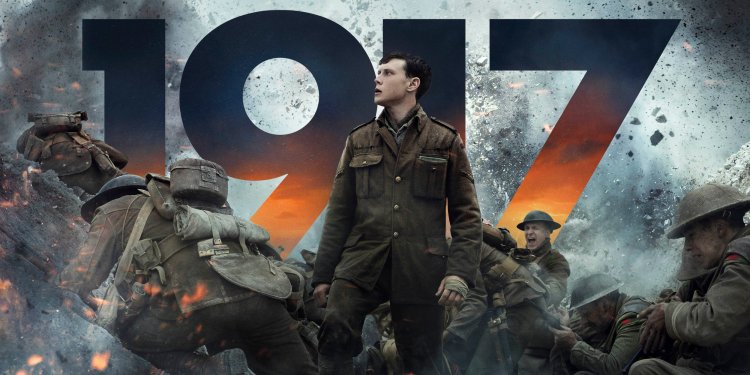
1917 Spoiler Review and most the Nerdy stuff.
Before we talk about anything else, it’s obvious that 1917 is unique in the way it’s shot. Sam Mendes has crafted a story that follows a journey of two young soldiers as they travel over enemy lines to deliver a message. Now because its a very personal story of these soldiers Mendes and his team of talent opted to make the film on a continuous shot or more accurately make it appear that way. Cleverly using objects and people to mask cuts in the film to make it look like the camera never leaves these characters. The editor’s in this film need credit where it’s due as they seamlessly stitched all of the shots together to make a journey that resonates with the audience as if they were there. It also makes it feel more of a real-life experience even though we have seen elements of this story many times before.
It would have been nearly impossible to actually film one continuous shot as mentioned above. There are parts of the film where they use objects or people to mask a shot changing, for now, we’ll call them stitch shots. Now because I had seen shots like this before in cinema before such as Birdman and the hallway scene in the second series of Netflix’s Daredevil I went into this film with the intention of counting all the “stitch shots” I could find. I counted 58 total “stitch shots” in this film it’s evident that I wouldn’t have spotted every one since the filmmakers did such a good job fitting these shots together. I tried to research how many shots were actually used in the film but alas no luck, so, for now, let’s just pretend there are actually 58 shots in this movie across the 2-hour runtime. It’s an impressive feat to achieve especially since one of the most poorly edited scenes in recent film history in my opinion from the biopic Bohemian Rhapsody has a scene that is roughly 2 minutes long and has a total of 62 shots for a scene that takes place at a small round table. So the fact that I only noticed 58 shots in this movie (only because I was actively looking for them) shows how much work the editors put into this film for me to only notice 58 shots when the average film, has around 1250 individual shots. For reference, if every 2 minutes has 62 shots in Bohemian Rhapsody the movie would only be 20 minutes if it stuck to 1250 shots. For reference on how long one shot on average for 1917 would be using only 58 shots on a 2-hour runtime, the average shot would be 2 minutes long – the same as the 62 shot 2-minute scene for Bohemian Rhapsody…Just let that sink in. I may have miscounted the shots but I ran through the scene twice and got 62 each time but here is the link if you want to check it out. https://www.youtube.com/watch?v=JNctAdr7jy4
Just on a side note on the “Oneshot” design, this film goes for. Towards the latter half of the film, Lance Corporal Schofield (George MacKay) is having a shoot out with a german soldier when he seems to shoot and kill him as he shoots from his vantage point. However, when Schofield goes up the tower and opens the door the german is slowly succumbing to his wounds but manages to shoot our hero in the head hitting his helmet and sending him tumbling down the staircase rendering him unconscious. This is when the film cuts to black for the first time ending the “Oneshot” but it didn’t bother me as it might other people as it made sense. We are following this character through HIS story if he isn’t conscious then there isn’t anyone there to tell it so it was just a clever way for time to pass that for me made sense.
As far as the story goes this is a pretty generic war film, Our main character/s have a mission and the have set a deadline to complete it or people will die. Battles ensue, they complete the mission, roll credits. But even though it has all the cliches through story and some dialogue I found my self enjoying this more than other war films that have done this over and over again many times before and it’s simply because of everything works. The Acting, The Editing, the music score the colour pallet and set design all work so well with each other it’s like I’m watching remastered documented footage of actual WWI soldiers. It feels real there are no over the top action sequences or have people getting shot or blown up just for the sake of it. Our hero only kills 3 people and one of them he tries to help before the latter turns on him. It’s artful how Mendes has created a sense of realism and shows the brutality of war without actually showing much brutality. As it happens, Its the aftermath of battles that we see that makes us as an audience go “oh my god this actually happened” and you feel more for the characters involved as it shows a side of war that isn’t just explosives and gunfire. Sam Mendes has a tongue in cheek sort of 4th wall break in the film that takes a jab at most war films in modern cinema as Captain Smith (Mark Strong) says “most men are just in it for the fight” which is what people expect with war films they go and watch a war film for the fighting and all the action. But what 1917 does well is it crafts one of the best War films I have ever seen using minimal brutality, Minimal huge action set pieces and instead uses Dialogue and atmosphere to create emotion and to show the horrors of war in a new and effective light.
Schofield and blake are our heroes with the camera putting Blake centre stage this, of course, is Mendes giving the audience a false sense of hope as it pitches him as the main character. I mean why wouldn’t it. The main character rarely dies in movies the mission they are given revolves around his character. But then plot twist he dies halfway through having getting stabbed by a german pilot they were trying to help. He then dies in Schofield’s arms and the story shifts. Schofield is now our only protagonist and sets out to complete the mission alone even though before Blakes death he was contemplating just going back to base. But if you watch closely at the opening scenes it actually pitches Schofield as the main character all along. For example, it keeps showing us that he as a small tin box with him if he wasn’t important why would the filmmakers linger on that. The box is important at the end of the fil we see the box has a photograph in it. A photo of his wife and child, which explains why when he bumps into the french widow with a baby he gives everything he has to help her and the child out. This is because he isn’t at home to help his family out they just like this french girl are without a complete family and he emphasises with this, making us empathize with this character. But we don’t know why, until the big reveal at the end as far as we know he hated home as mentioned by him earlier but this is clearly a cover-up adding to the character and seeing he is burying his feelings and just like us is, in fact, human and not just this invincible emotionless action man.
Now enough on the story and let’s just focus on the little details I noticed in this film to finish up. First of all the Injury, Schofield gets in the opening scene to No-mans land. He cuts open his left hand helping Blake through some barbed wire. He wraps it up and Blake jokes that “Hey you’ll be Wanking again in no time” to which Schofield responds “Its the wrong hand”
Giving the impression that Schofield is right-handed. But throughout the film, Schofield proves that his dominant hand is, in fact, his left (the injured one) these scenes include;
- When Schofield uses his left hand to move the barbed wire. Why would he use his weakest hand to move it?
- When they climb into the crater and blake knocks into him he puts his left hand down first to stop himself falling and accidentally puts it into the stomach of a dead body
- When blake is dying he holds him upright with his left arm again why would he use his weakest
- When the truck gets stuck in the mud and Schofield and the men manage to push it out, he falls to the floor putting his left hand in the mud to stop himself from submerging fully into it, why not use his So-called dominant hand.
- The way he holds his rifle is the same way I would hold it. (I’m left-handed)
- And jumping across the broken bridge when he is getting shot at he grabs the rail with his left hand first
This may a just my be coincidence but there is a lot to back this up so I think Mendes did this on purpose but I’m just not 100% sure why. So I can’t comment on it but any theories let me know.
A few small details are how the colours palette changes depending on scenes in order the show safety or danger. How Blake slowly gets paler as he loses blood which is what would actually happen. But the biggest detail is how the ending plays out in reverse to mirror the opening. The opening goes as follows; Schofield and blake are sat against a tree they then walk through the barracks to the trenches to the command quarters. They then leave and walk through other trenches into a potential battle. The ending has Schofield in a battle then in trenches walking to command quarters. Then in the trenches again to the barracks then to the tree. Where we get the reveal of him having a family the scene plays out entirely in reverse the only difference is Blake is now absent.
Overall 1917 is something special and other war films in the future can learn and should learn from it. Everything seamlessly fits together and you can feel the passion everyone involved had and it shows through a spectacular piece of cinema that I’m excited to watch it again. Even though some of the grippingly tense scenes may lose their edge as I know how they will pan out. But more for the small details and to appreciate Sam Mendes and his team have put in to craft a masterclass of storytelling and Cinema.
There is plenty more to talk about but this entry is already long enough so to shortened things down here are my notes I penned whilst watching the movie in cinemas, after rewatches I might add a new entry. But for now, this is it.
- Opening title April 6th 1917
- Battlefield makes Schofield hate home?
- Continuity is on point
- Rescue Mission Cliche?
- Rudyard Kipling quote “Down to Gehenna or up to the Throne, He travels fastest who travels alone”
- Blake acts brave but actually a coward? Solider confrontation?
- Hand Injury?
- Injured Hand always danger?
- Mission to german Frontline-No mans land minimal but haunting.
- The music score is great.
- Tripwire scene caught me off guard
- Rats??
- One wants a medal the other doesn’t care?
- The humanity of the soldiers-Helping the German
- Blakes death scene was agonizing to watch
- He got paler close to death.
- Schofield writing to Blakes mum promise. Does he follow it through?
- A false sense of main characters safety
- The cliche “tell my family I love them” quote
- No Stitch shot through whole death scene around 8 minutes long?
- Solider crying in the background over a dead dog?
- “Some men just want the fight” – Mark Strong
- Bridge shoot out was tense.
- Blacked out halfway ending the one-shot?
- When Schofield wakes up the colour pallet of orange and yellows give an apocalyptic feel to it.
- Giving all he had to help the woman and child. (maybe personal reasons)
- Impressive how long some shots are.
- Does the song he sang to the baby mean something?
- Colour pallet changes constantly
- Cherry Blossom call back to Blake
- “It looks like its snowing in the autumn”
- Great shot where the soldiers just seem to merge with the trees but suddenly come into view (its the singing scene)
- I think I noticed people who looked a little underage for the army a common thing people did was lie about their age so that they could fight? but maybe not?
- Literal goosebumps when he ran across the battlefield to stop the attack.
- Didn’t want to do it at the start but solely finished the mission
- “Hope is a dangerous thing”
- Loved the shots of the aftermath
- Hints that Schofield is Left-handed despite him saying he was right-handed
- The ending shot mirrors the first.
- Counted 58 stitch shots.
Final Score.
Title:Great
1917 delivers a moving story of determination and shows the horrors and struggles of world war 2 soldiers in a creative and masterful new light thank to the direction from Sam Mendez.


 Head Over Reels